Rolo Suffering Seizures
Case Study: Cluster Seizures in a 4-Year-Old Dachshund with a Normal Brain MRI

Veterinary Outpatient MRI
By Mark Soderstrom, DVM, Medical Director, Veterinary Outpatient MRI
Signalment & Presentation
Rolo, a 4-year-old male Dachshund, presented with cluster seizure activity despite ongoing anticonvulsant therapy (levetiracetam), with phenobarbital recently initiated.
Clinical history and referring records indicated:
- Recurrent seizure activity with increasing frequency and clustering
- Post-ictal neurologic abnormalities, including disorientation and ataxia
- Requirement for emergency stabilization and hospitalization due to severity
- Baseline laboratory evaluation without a clear metabolic etiology
At presentation for imaging, neurologic examination was reported as within normal limits .
Clinical Problem
This case represents a common but critical neurologic decision point:
Is this seizure disorder structural or functional?
Differential diagnoses at this stage include:
- Intracranial neoplasia
- Inflammatory or infectious encephalitis
- Vascular insult
- Idiopathic epilepsy
Given the patient’s age, progression, and cluster pattern, advanced neuroimaging was indicated to rule out structural disease.
MRI Protocol
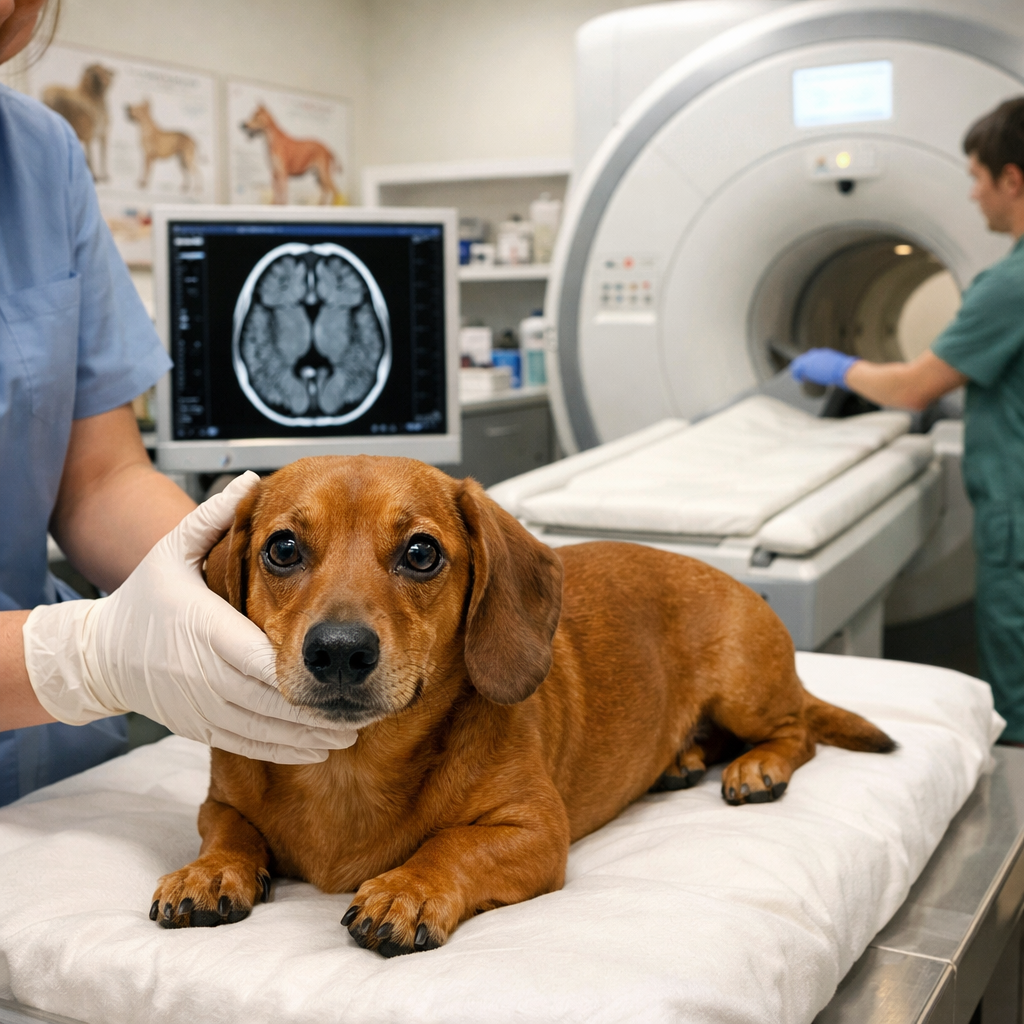
A complete brain MRI was performed, including:
- T2-weighted sequences
- T2 FLAIR
- T1 pre- and post-contrast
- T2* (gradient echo)
- Diffusion-weighted imaging (DWI) with ADC mapping
This protocol is designed to evaluate for:
- Mass lesions
- Inflammatory changes
- Hemorrhage
- Ischemic injury
- Subtle parenchymal abnormalities
MRI Findings
The study demonstrated:
- Normal brain parenchyma
- Normal pituitary morphology and signal intensity
- No meningeal enhancement
- No evidence of mass effect, edema, or structural abnormality
Conclusion:
Normal brain MRI
Interpretation
A normal MRI in this clinical context carries significant diagnostic weight.
In a young dog with:
- Cluster seizures
- Normal neurologic exam between episodes
- Unremarkable laboratory work
- No imaging abnormalities
…the leading diagnosis becomes:
Idiopathic epilepsy
Clinical Implications
1. Structural disease effectively ruled out
The absence of:
- Mass lesions
- Inflammatory changes
- Contrast enhancement
makes neoplasia and active encephalitis highly unlikely.
2. Prognosis shifts favorably
While cluster seizures are serious, the absence of structural pathology:
- Improves overall prognosis
- Supports long-term medical management
- Reduces the likelihood of progressive intracranial disease
3. Treatment strategy becomes targeted
Management should now focus on:
- Optimization of anticonvulsant therapy
- Combination therapy when indicated (e.g., levetiracetam + phenobarbital)
- Monitoring for breakthrough seizure activity
Further diagnostics (e.g., CSF analysis) may be considered selectively but are not mandatory in the setting of a normal MRI and stable neurologic exam.
Key Takeaway for Referring Veterinarians
This case underscores a critical point:
MRI is not only diagnostic—it is decisional.
A normal brain MRI:
- Eliminates the most serious differentials
- Allows confident classification as idiopathic epilepsy
- Prevents unnecessary escalation toward invasive or empirical treatments
Summary
Rolo’s case illustrates the value of MRI in seizure workups:
- Cluster seizures prompted appropriate escalation to advanced imaging
- MRI ruled out structural intracranial disease
- Diagnosis narrowed to idiopathic epilepsy
- Treatment pathway clarified and prognosis improved